4. What is Network Cabling?
Cable is the medium
through which information usually moves from one network device to another.
There are several types of cable which are commonly used with LANs. In some
cases, a network will utilize only one type of cable, other networks will use a
variety of cable types. The type of cable chosen for a network is related to
the network's topology, protocol, and size. Understanding the characteristics
of different types of cable and how they relate to other aspects of a network
is necessary for the development of a successful network.
The following sections
discuss the types of cables used in networks and other related topics.
4.1 Unshielded Twisted Pair (UTP) Cable
4.2 Shielded Twisted Pair (STP) Cable
4.3 Coaxial Cable
4.4 Fiber Optic Cable
4.5 Cable Installation Guides
4.6 Wireless LANs
4.1 Unshielded Twisted Pair (UTP) Cable
Twisted pair cabling
comes in two varieties: shielded and unshielded. Unshielded twisted pair (UTP)
is the most popular and is generally the best option for school networks.
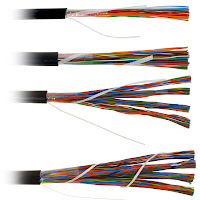 |
| Unshielded twisted pair |
The quality of UTP may
vary from telephone-grade wire to extremely high-speed cable. The cable has
four pairs of wires inside the jacket. Each pair is twisted with a different
number of twists per inch to help eliminate interference from adjacent pairs
and other electrical devices. The tighter the twisting, the higher the
supported transmission rate and the greater the cost per foot. The EIA/TIA
(Electronic Industry Association/Telecommunication Industry Association) has
established standards of UTP and rated six categories of wire (additional
categories are emerging).
Categories of Unshielded Twisted Pair
Category
|
Speed
|
Use
|
1
|
1 Mbps
|
Voice Only (Telephone Wire)
|
2
|
4 Mbps
|
LocalTalk & Telephone (Rarely
used)
|
3
|
16 Mbps
|
10BaseT Ethernet
|
4
|
20 Mbps
|
Token Ring (Rarely used)
|
5
|
100 Mbps (2 pair)
|
100BaseT Ethernet
|
1000 Mbps (4 pair)
|
Gigabit Ethernet
|
|
5e
|
1,000 Mbps
|
Gigabit Ethernet
|
6
|
10,000 Mbps
|
Gigabit Ethernet
|
Unshielded Twisted Pair Connector
The standard connector
for unshielded twisted pair cabling is an RJ-45 connector. This is a plastic
connector that looks like a large telephone-style connector. A
slot allows the RJ-45 to be inserted only one way. RJ stands for Registered
Jack, implying that the connector follows a standard borrowed from the
telephone industry. This standard designates which wire goes with each pin
inside the connector.
 |
| RJ-45 connector |
4.2 Shielded Twisted Pair (STP) Cable
Although UTP cable is
the least expensive cable, it may be susceptible to radio and electrical
frequency interference (it should not be too close to electric motors,
fluorescent lights, etc.). If you must place cable in environments with lots of
potential interference, or if you must place cable in extremely sensitive
environments that may be susceptible to the electrical current in the UTP,
shielded twisted pair may be the solution. Shielded cables can also help to
extend the maximum distance of the cables.
 |
| Shielded twisted pair |
Shielded twisted pair cable is available in three different configurations:
1.
Each pair of wires is
individually shielded with foil.
2.
There is a foil or braid
shield inside the jacket covering all wires (as a group).
3.
There is a shield around
each individual pair, as well as around the entire group of wires (referred to
as double shield twisted pair).
4.3 Coaxial Cable
Coaxial cabling has a
single copper conductor at its center. A plastic layer provides insulation
between the center conductor and a braided metal shield. The metal
shield helps to block any outside interference from fluorescent lights, motors,
and other computers.
 |
| Coaxial cable |
Although coaxial cabling
is difficult to install, it is highly resistant to signal interference. In
addition, it can support greater cable lengths between network devices than
twisted pair cable. The two types of coaxial cabling are thick coaxial and thin
coaxial.
Thin coaxial cable is
also referred to as thinnet. 10Base2 refers to the specifications for thin
coaxial cable carrying Ethernet signals. The 2 refers to the approximate
maximum segment length being 200 meters. In actual fact the maximum segment
length is 185 meters. Thin coaxial cable has been popular in school networks,
especially linear bus networks.
Thick coaxial cable is
also referred to as thicknet. 10Base5 refers to the specifications for thick
coaxial cable carrying Ethernet signals. The 5 refers to the maximum segment
length being 500 meters. Thick coaxial cable has an extra protective plastic
cover that helps keep moisture away from the center conductor. This makes thick
coaxial a great choice when running longer lengths in a linear bus network. One
disadvantage of thick coaxial is that it does not bend easily and is difficult
to install.
Coaxial Cable Connectors
The most common type of
connector used with coaxial cables is the Bayone-Neill-Concelman (BNC)
connector. Different types of adapters are available for BNC
connectors, including a T-connector, barrel connector, and terminator.
Connectors on the cable are the weakest points in any network. To help avoid
problems with your network, always use the BNC connectors that crimp, rather
screw, onto the cable.
| BNC connector |
4.4 Fiber Optic Cable
Fiber optic cabling
consists of a center glass core surrounded by several layers of protective
materials. It transmits light rather than electronic signals
eliminating the problem of electrical interference. This makes it ideal for
certain environments that contain a large amount of electrical interference. It
has also made it the standard for connecting networks between buildings, due to
its immunity to the effects of moisture and lighting.
Fiber optic cable has
the ability to transmit signals over much longer distances than coaxial and
twisted pair. It also has the capability to carry information at vastly greater
speeds. This capacity broadens communication possibilities to include services
such as video conferencing and interactive services. The cost of fiber optic
cabling is comparable to copper cabling; however, it is more difficult to
install and modify. 10BaseF refers to the specifications for fiber optic cable
carrying Ethernet signals.
The center core of fiber
cables is made from glass or plastic fibers. A plastic coating then
cushions the fiber center, and kevlar fibers help to strengthen the cables and
prevent breakage. The outer insulating jacket made of teflon or PVC.
 |
| Fiber optic cable |
There are two common
types of fiber cables -- single mode and multimode. Multimode cable has a
larger diameter; however, both cables provide high bandwidth at high speeds.
Single mode can provide more distance, but it is more expensive.
Cable
Type
|
|
10BaseT
|
Unshielded Twisted Pair
|
10Base2
|
Thin Coaxial
|
10Base5
|
Thick Coaxial
|
100BaseT
|
Unshielded Twisted Pair
|
100BaseFX
|
Fiber Optic
|
100BaseBX
|
Single mode Fiber
|
100BaseSX
|
Multimode Fiber
|
1000BaseT
|
Unshielded Twisted Pair
|
1000BaseFX
|
Fiber Optic
|
1000BaseBX
|
Single mode Fiber
|
1000BaseSX
|
Multimode Fiber
|
4.5 Installing Cable - Some Guidelines
- When running cable, it is best to follow a few simple rules:
- Always use more cable than you need. Leave plenty of slack.
- Test every part of a network as you install it. Even if it is brand new, it may have problems that will be difficult to isolate later.
- Stay at least 3 feet away from fluorescent light boxes and other sources of electrical interference.
- If it is necessary to run cable across the floor, cover the cable with cable protectors.
- Label both ends of each cable.
- Use cable ties (not tape) to keep cables in the same location together.
